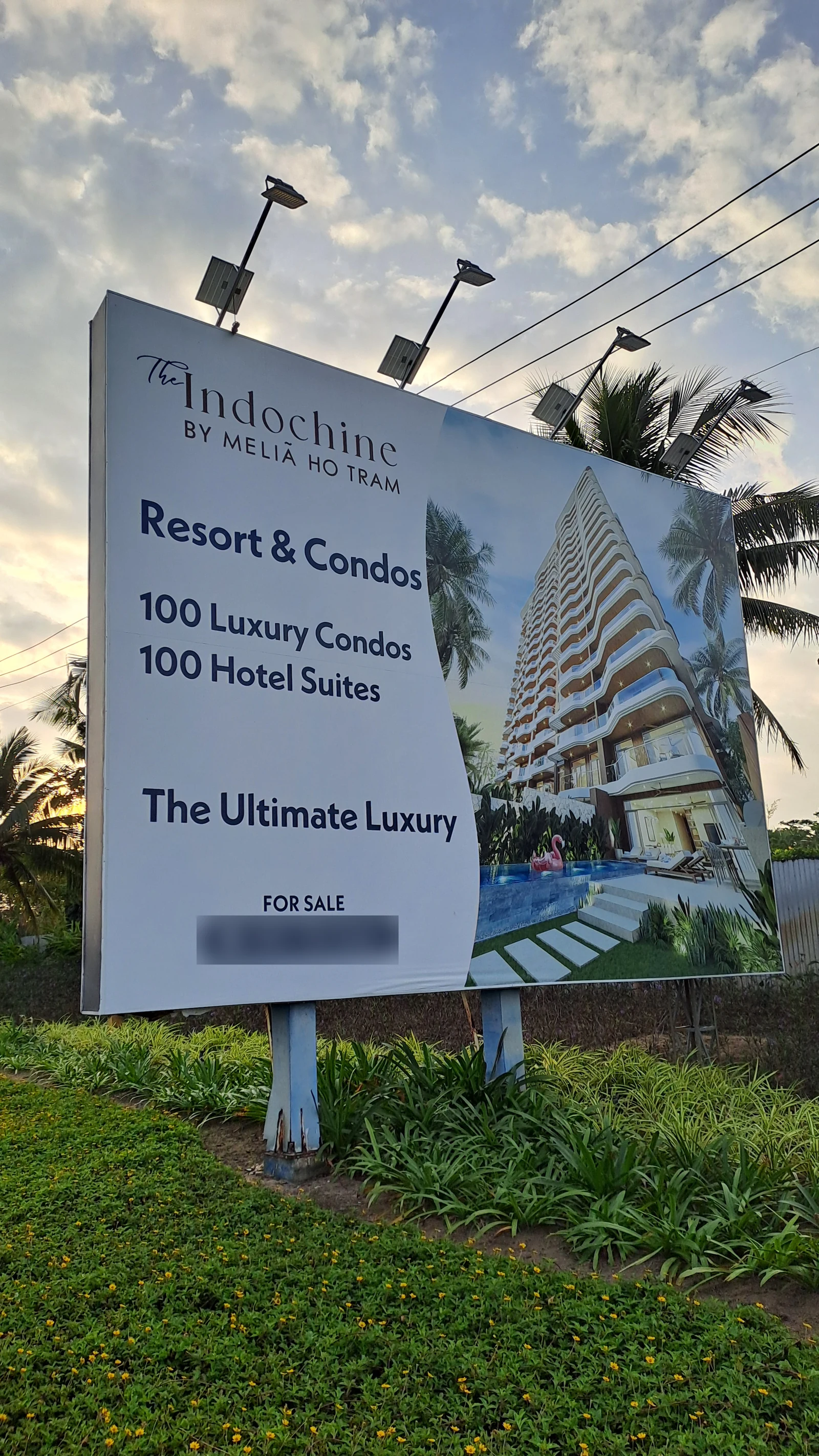
The sign at the side of the road says The Indochine by Meliá Ho Tram. Under it: Resort & Condos. 100 Luxury Condos. 100 Hotel Suites. The Ultimate Luxury. For Sale. Behind it, coconut palms and a strip of scrub that still looks like the coast it is advertising.
We have written about Hồ Tràm before — the tide that goes out half a kilometre, the crab market at dawn, the resorts arriving on a shoreline that is already eroding. This is the follow-up, because a great deal has happened since, some of it on paper and some of it on the beach.
It is now part of Ho Chi Minh City
On 1 July 2025 Vietnam redrew its provinces. Bà Rịa–Vũng Tàu and Bình Dương were merged into Ho Chi Minh City, which now covers more than 6,700 square kilometres and fourteen million people. The old Xuyên Mộc district was abolished and replaced by communes; one of them is called Hồ Tràm, formed from Phước Bửu, Phước Tân and Phước Thuận, about 95 square kilometres in all.
It sounds like a bureaucratic footnote. It is not. A quiet stretch of fishing coast two hours from the city is now, legally, the city’s own seaside. That changes who plans it, who invests in it, and how fast.
The casino opened its doors the week we arrived
The Grand Hồ Tràm, the casino resort at the centre of the Hồ Tràm Strip, opened its first phase in July 2013. Its majority owner since 2019 has been an affiliate of the American private equity firm Warburg Pincus. In May 2025 it broke ground on a one-billion-dollar expansion, part of a master plan reported at 4.2 billion.
Until this year the casino floor was open to foreigners only. Under a five-year pilot approved by the government in November 2025, it began admitting Vietnamese citizens on 6 January 2026. We filmed in the gardens down the coast on 7 January. We did not know at the time; we found out writing this.
Trade reporting in April 2026 described Vietnam’s casino resorts as struggling to make a profit under the pilot. Whatever happens next, the decision to let local people in is the largest single change to this coast’s economy since the Strip was planned, and it is worth knowing about before you book a quiet family holiday here.
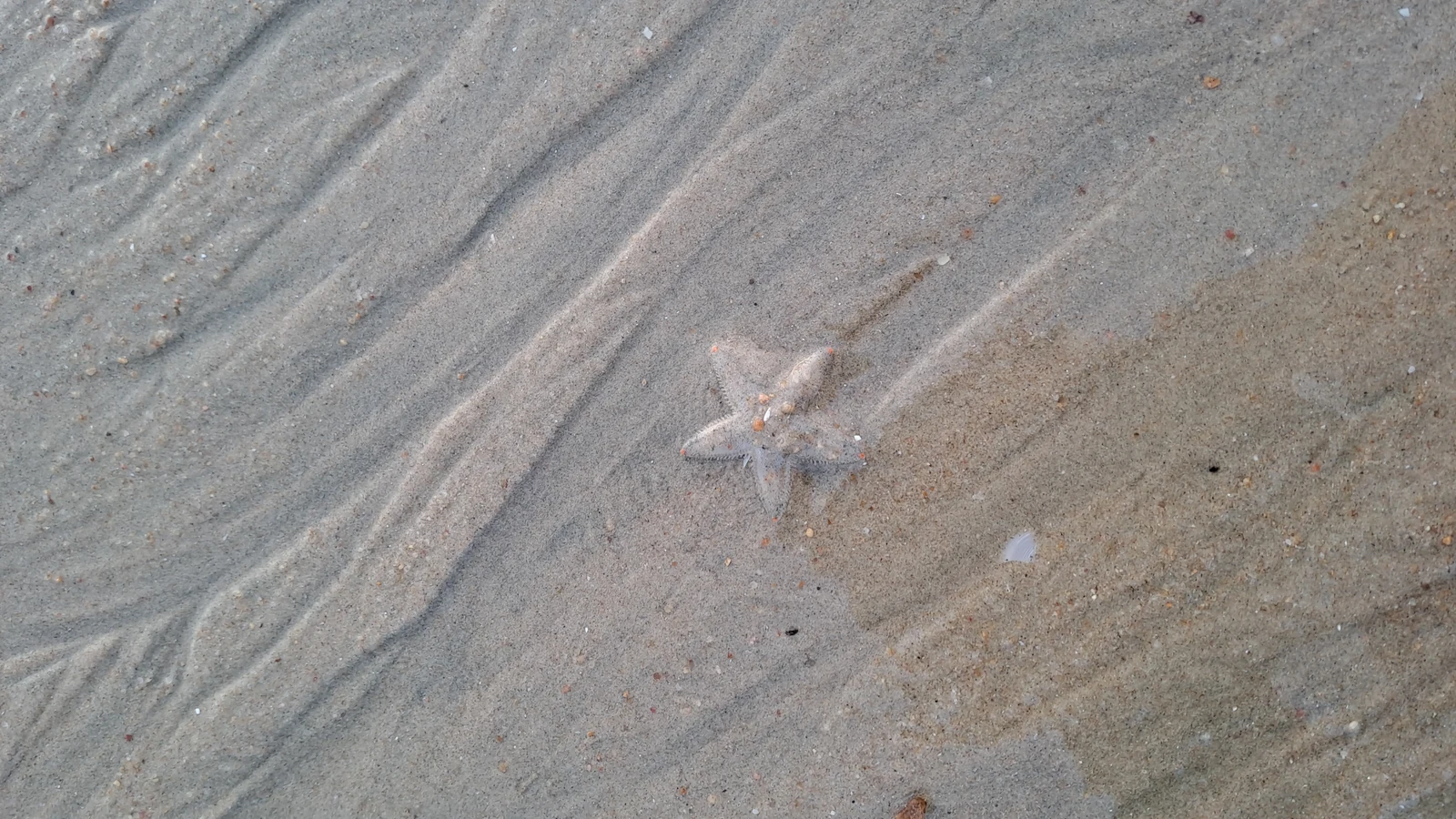
Condominiums sold by the hundred on one side of the road. Starfish in the shallows on the other. Both are Hồ Tràm in 2026.
What the tide still does
The beach is the same. At low tide the sea pulls back across a flat that seems to go on for ever, and the wet sand holds the sky like a mirror. Small starfish lie in the shallow film of water. For a child it is a shore to learn on, with one rule. Look, do not lift: a starfish out of water for a photograph is a starfish being harmed for a photograph.
The whale that rescues fishermen
Along this coast, and across the fishing communities of southern Vietnam, the whale is not a fish. It is Cá Ông — Lord Fish — a guardian believed to carry drowning sailors to shore. Whales that wash up dead are given funerals. Their bones are kept in shrines.
The festival that honours them is Nghinh Ông, “welcoming the Lord”. Its dates vary village by village. At Phước Hải, up the coast, it falls on the sixteenth and seventeenth days of the second lunar month; at Vũng Tàu, at the Thắng Tam shrine, on the sixteenth to eighteenth of the eighth lunar month, and Vietnam’s culture ministry once named it one of the country’s fifteen major festivals. The provincial museum records it being celebrated at Bình Châu too. We could not find a confirmed date for Hồ Tràm itself, so ask locally rather than trust a calendar.
If you are there for one, go. It is a working ritual of people whose livelihoods depend on the sea, and it is one of the best answers to the question of what this coast was before the billboards.
The forest behind the dunes
A few minutes inland is the Bình Châu–Phước Bửu Nature Reserve, reported at between ten and a half and eleven thousand hectares: tropical semi-deciduous forest growing almost to the sand, coastal dunes, wetland, and stands of Vietnamese rosewood, cẩm lai. We could not confirm the year it was established — sources give 1975 and 1978 — and the species counts published for it do not add up, so we are not quoting them. What is not in doubt is that it is there, it is large, and it is the reason this coast still has a green edge.
Further along, at Bình Châu, are hot springs, now run as a commercial resort over about twelve hectares. The operator says the water reaches up to 82 degrees at the source and is cooled before you bathe in it; we found no independent measurement. For a family, a warm pool fed from underground on the afternoon the sea is too rough is a very good afternoon.
Why it is still on this site
Because the tide, the forest and the whale shrines are still here, and they are what make this coast worth the drive. Because the change is happening in public, with dates and numbers, and you can choose where your money goes. And because a place in the middle of being transformed is exactly the place where how visitors behave still makes a difference.
What we actually know
- Bà Rịa–Vũng Tàu and Bình Dương merged into Ho Chi Minh City on 1 July 2025; the new city covers 6,772.59 km² with 14,002,598 people (Resolution 202/2025/QH15). Xuyên Mộc district replaced by communes including Hồ Tràm (Phước Bửu, Phước Tân and Phước Thuận), 94.51 km² (Resolution 1685/NQ-UBTVQH15, 16 June 2025).
- The Grand Hồ Tràm: owned by Asian Coast Development Ltd; a Warburg Pincus affiliate became majority owner on 19 July 2019 (GGRAsia). First phase opened July 2013; US$1 billion expansion broke ground in May 2025 within a US$4.2 billion master plan (Asgam).
- Government resolution of 26 November 2025 granted Hồ Tràm a five-year pilot for Vietnamese citizens (AGBrief; The Investor). Vietnamese players admitted from 6 January 2026 (World Casino Directory News). Vietnamese casino resorts reported struggling to turn a profit under the pilot (AGBrief, April 2026).
- The billboard is our own photograph, taken in January 2026; we have blurred the sales telephone number.
- Cá Ông whale veneration and the Nghinh Ông festival: Phước Hải, 16th–17th of the 2nd lunar month; Vũng Tàu (Thắng Tam), 16th–18th of the 8th lunar month, named among 15 major festivals by the Ministry of Culture in 2000; also celebrated at Bình Châu (Bà Rịa–Vũng Tàu Provincial Museum). No confirmed date found for Hồ Tràm itself.
- Bình Châu–Phước Bửu Nature Reserve: reported area over 10,500 ha (Tuổi Trẻ, July 2026) or 11,293 ha (VNA); semi-deciduous forest, dunes and wetland including cẩm lai. Establishment year unconfirmed (1975 or 1978 in different sources).
- Bình Châu hot springs: commercial resort of about 12 ha; temperatures up to about 82°C at source reported by the operator and tourism bodies, not independently measured.
- Dry season November to April; rainy season May to October; about 1,500 mm of rain a year in the former province.
This follows our earlier pieces on the Hồ Tràm coast and on Meliá Hồ Tràm, and does not repeat what they cover. The billboard advertises a development connected by name to the resort we stayed at; we have no relationship with either.
This story is not sponsored, not affiliated and not a paid placement. Every stay, meal and journey was found, booked and paid for at our own cost, and nobody we mention knew we were writing. The impressions of people are ours — what we saw, in the places we were, in a few weeks — and not a claim about a nation of a hundred million. Every fact is attributed to a source you can check. We write only about places that meet the criteria this site was built on: mindful travel, family-friendliness, real sustainability practice, places with a soul, immersive cultural travel, a connection to nature, and experiences worth the journey.