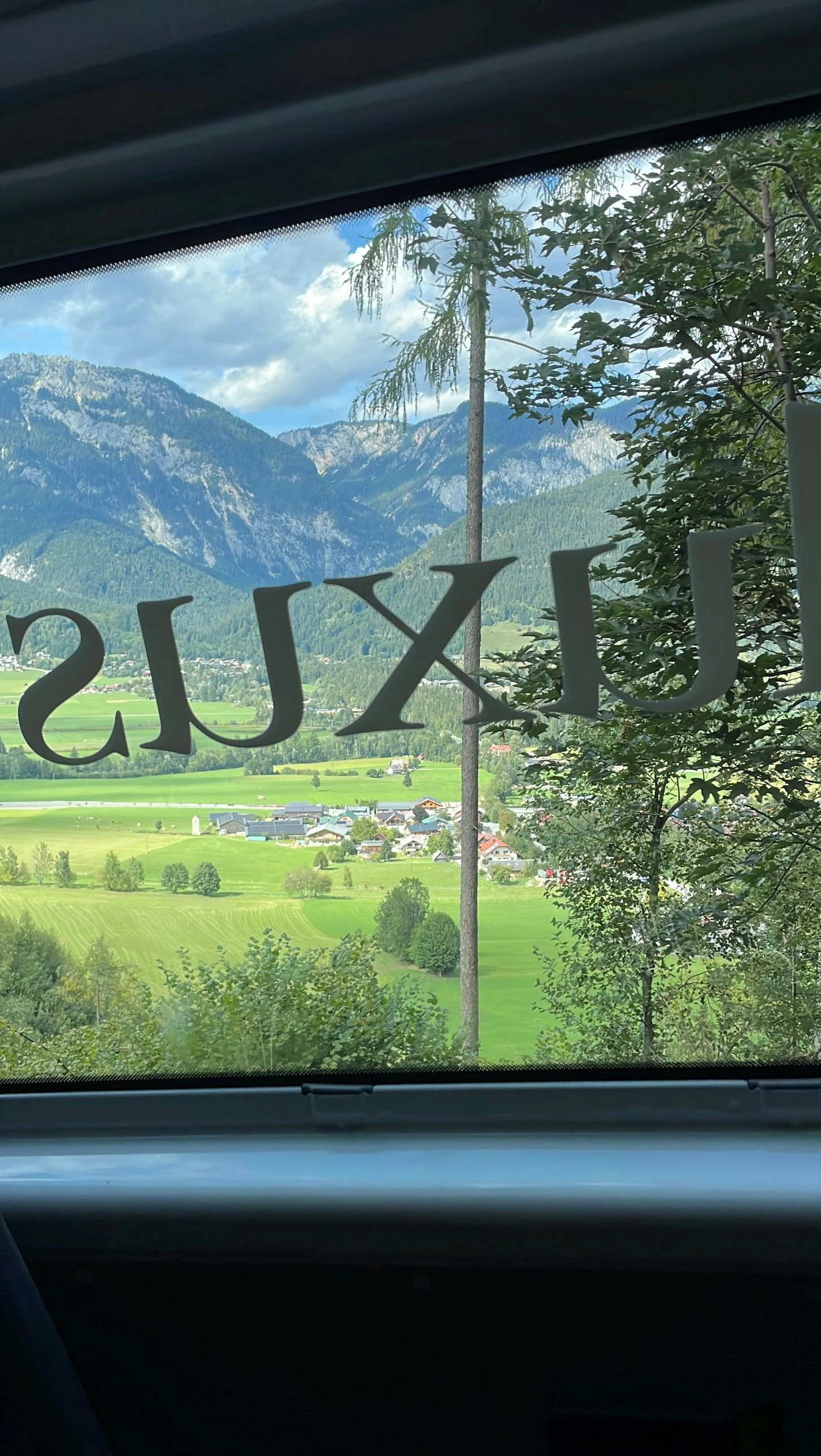
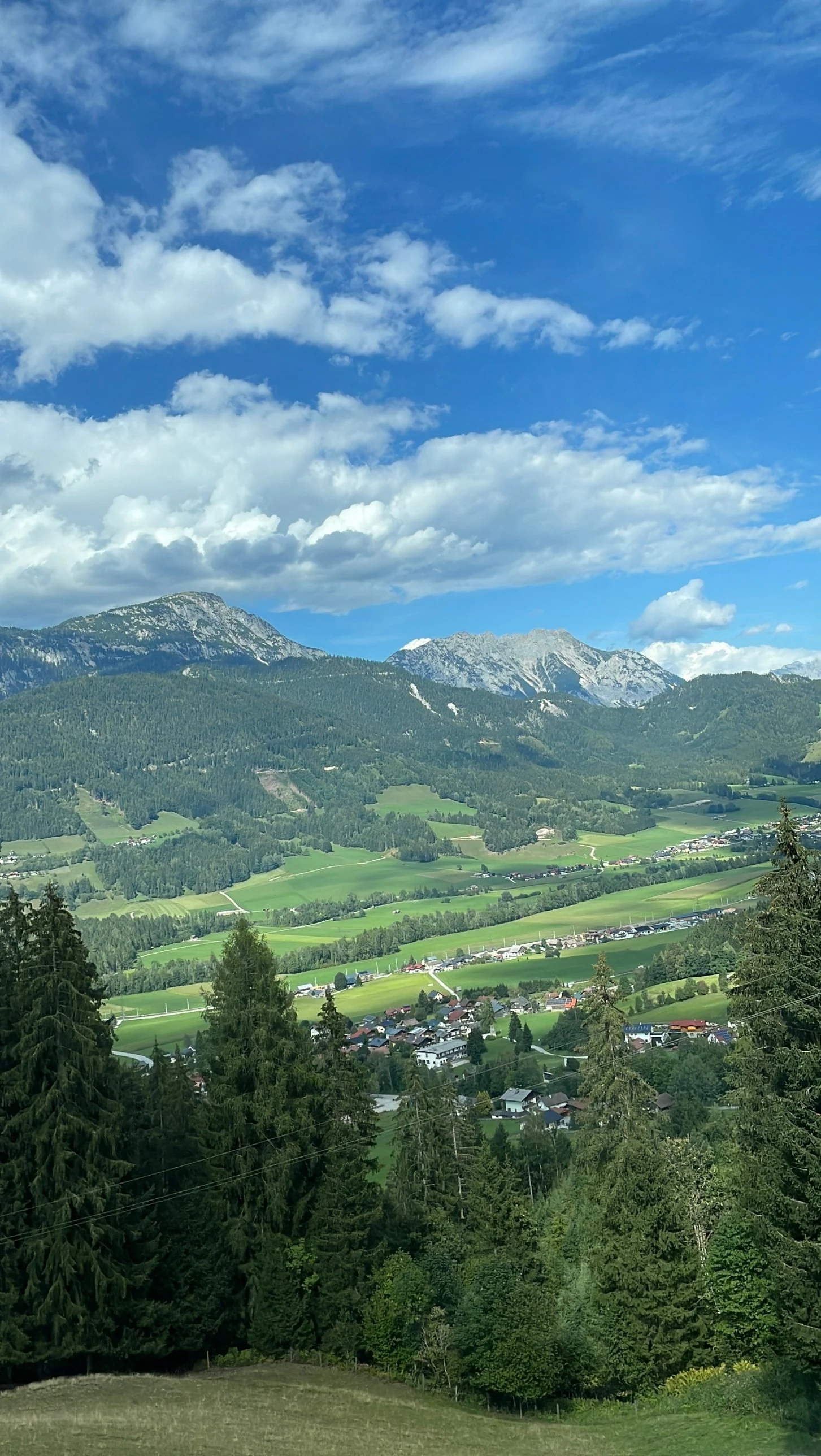
The valley arrives through a window. On the way up to Gumpenberg the shuttle climbs above Haus im Ennstal, lettering on the glass reading backwards, and the Ennstal opens out below: a flat green floor of hay meadows and farm roofs, spruce on the slopes, limestone peaks along the far side.
It is a working valley, not scenery. Cows lie in the meadows on the slope. The grass they are lying in will be cut for hay before the year is out.
A family history kept on the wall
Inside, the history is not in a brochure. It hangs in a corridor, board by board, decade by decade, with the photographs that go with it. The first board, 1900 to 1957, shows a hillside of hay meadow with two dark farm buildings on it and almost nothing else.
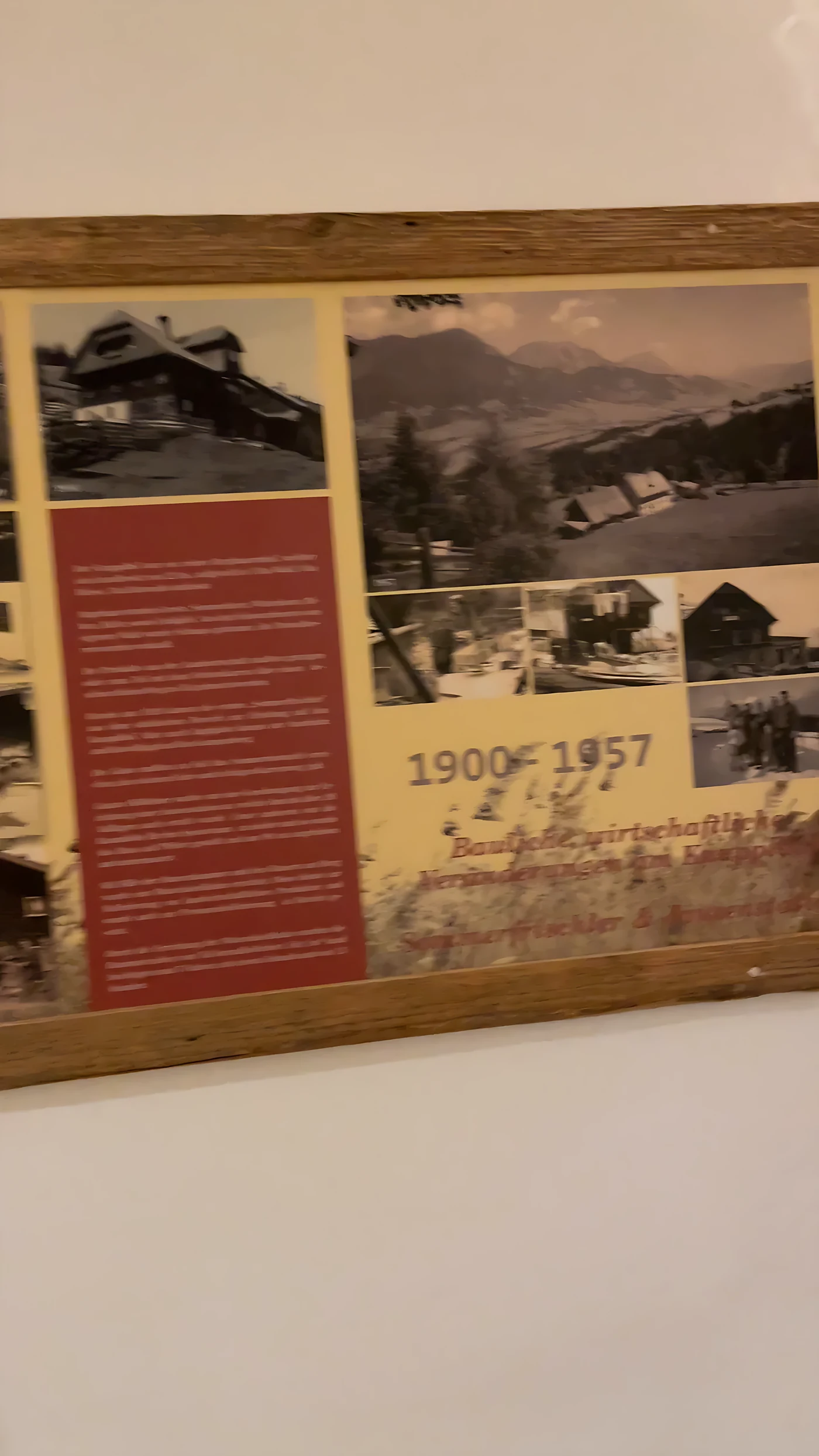
The sequence runs the right way round. The Knappl farmhouse dates from 1729. The Höflehner family has been on this ground since 1810. In 1957 they began feeding walkers at a Jausenstation, a farm that serves passers-by bread, cheese and cold meat, and let the first guest rooms. Red deer came in 1983. The hotel came last, in 2009.
The farm came first. The hotel is the newest thing on the hillside.
That is why this place is on Atlántis. A family that keeps the lean decades on display is not editing its story. And land held by one family for seven generations tends to be looked after as if the next one is already coming.
The valley on the plate, and on the road
Two things tie a stay here to the valley rather than to a building. The first is Ennstaler Steirerkas: a hard, sharp sour-milk cheese made in this valley, with a Protected Designation of Origin since 2021. It is the most Styrian thing you can eat here, and worth trying once even if you never order it again.
The second is the Almabtrieb. In late September the cattle come down from the high pastures in flower headdresses. At Ramsau, below the Dachstein, it falls on 25 and 26 September in 2026. It is a working day in the farm calendar that visitors are allowed to watch, not a show put on for them.
Come for that weekend if you can choose. Arrive by train if you can manage it. Then sit on the hillside and watch the valley do what it has done for three hundred years.
What we actually know
- Knappl farmhouse dated 1729; the Höflehner family on the property from 1810; Jausenstation and first guest rooms 1957; red deer from 1983; four-star hotel 2009. Source: the family’s own published history, matching the corridor boards we photographed.
- Altitude 1,117 metres, at Gumpenberg above Haus im Ennstal, Bezirk Liezen, Styria. The municipality lies within Natura 2000 site AT2204000.
- Ennstaler Steirerkas registered as a Protected Designation of Origin in 2021.
- Ramsau am Dachstein Almabtrieb, 25 and 26 September 2026.
- Schladming and Haus im Ennstal stations are on the Salzburg–Graz line; the hotel runs a shuttle from the station.
Photographs and footage from 30 and 31 August 2026. We did not ask the hotel for comment and received nothing from it.
Independent and self-funded. Atlántis is not sponsored by design: not affiliated, not a paid placement, and nobody we write about knew in advance. The stay was found, booked and paid for at our own cost. The views are our own, judged against the Atlántis values: sustainability, cultural immersion, eco travel, real experiences, family-friendliness, and car-free travel or the deep past, depending on the place. No person appears in any photograph or clip on this page, and every clip is silent.