The boats are moored on the Esplanade, a few minutes' walk from the hotel, between the casino and the town park. You pay by the half hour. There is no licence to show and no form to sign beyond the hire slip. The boat takes four people, has a tiller rather than a wheel, and moves at roughly the speed of a determined walker. A child can hold the tiller the whole way and nothing much will happen.
That slowness is not a quirk of the hire fleet. It is the law. Combustion engines are prohibited on the lakes of Salzburg province. What is left on the water is electric, or paddled, or sailed, and the practical effect is that the loudest thing on the Zeller See on a still afternoon is the passenger boat's wake slapping the stone embankment several minutes after it has gone past.
Push out three hundred metres and the proportions change. From the promenade the Grand Hotel reads as a long white front on a lakeside road. From the lake you can see what it actually is: a building on a peninsula pushed out into the water.
The hotel's own jubilee journal explains why the peninsula is there. The Schmittenbach carried schist and earth down off the Schmittenhöhe for thousands of years and built an alluvial fan into the lake. Then, in the late 1880s, the man who built the hotel drove piles into the water and made the spur bigger, because the building he had in mind was longer than the ground he had bought.
Knowing that makes sense of the interior, where you walk out of a marble hall with white ironwork into a corridor of quite different proportions and wonder when the building changed its mind.
The loudest thing on the lake is a wake arriving several minutes after the boat that made it.
What the water is
Turn south and the view opens down the length of the lake toward the Kitzsteinhorn, which still carries a glacier. The Zeller See is small enough to cross in an afternoon and deep enough to be serious: 4.55 square kilometres, and just under seventy metres at its deepest point.
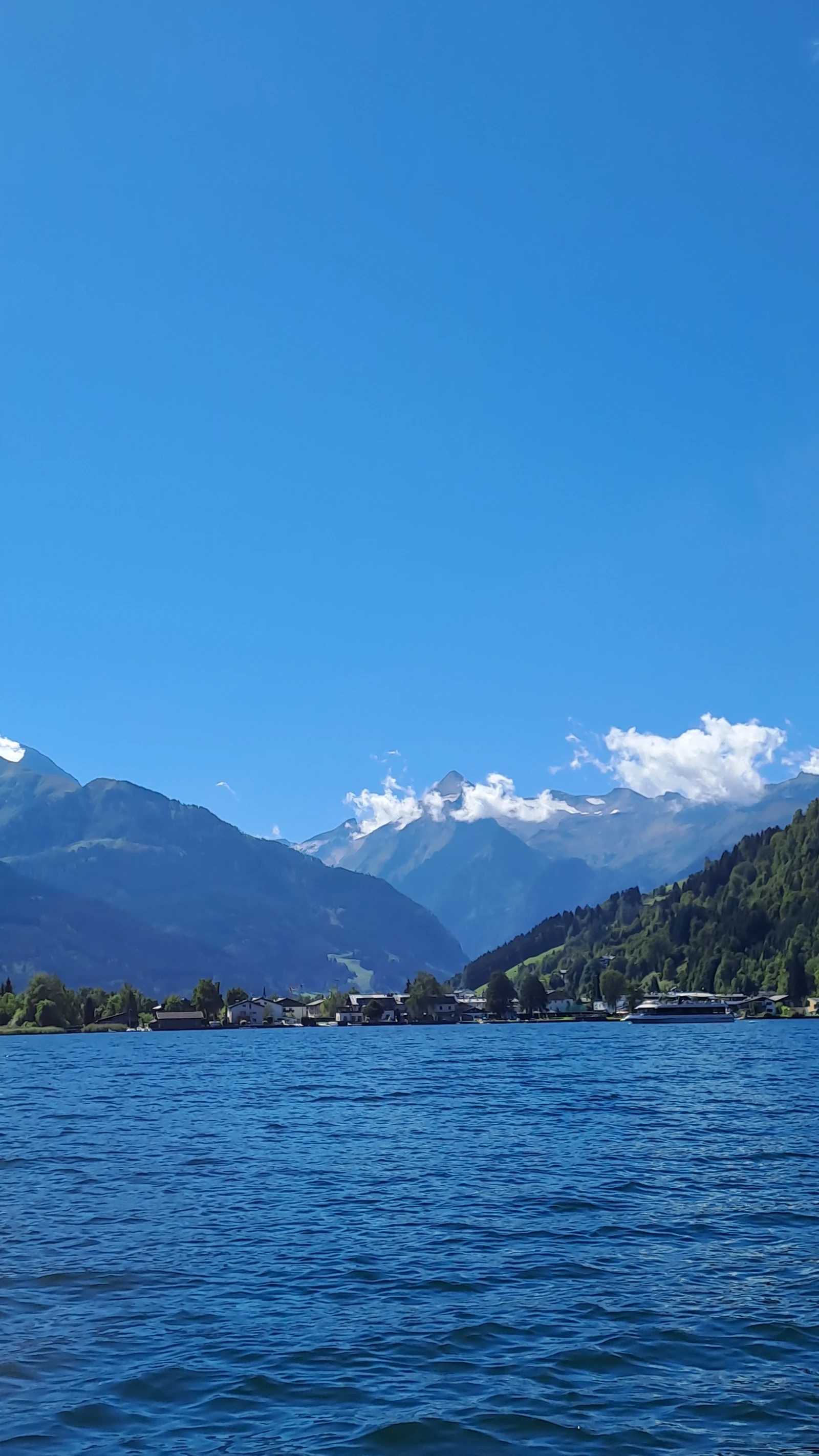
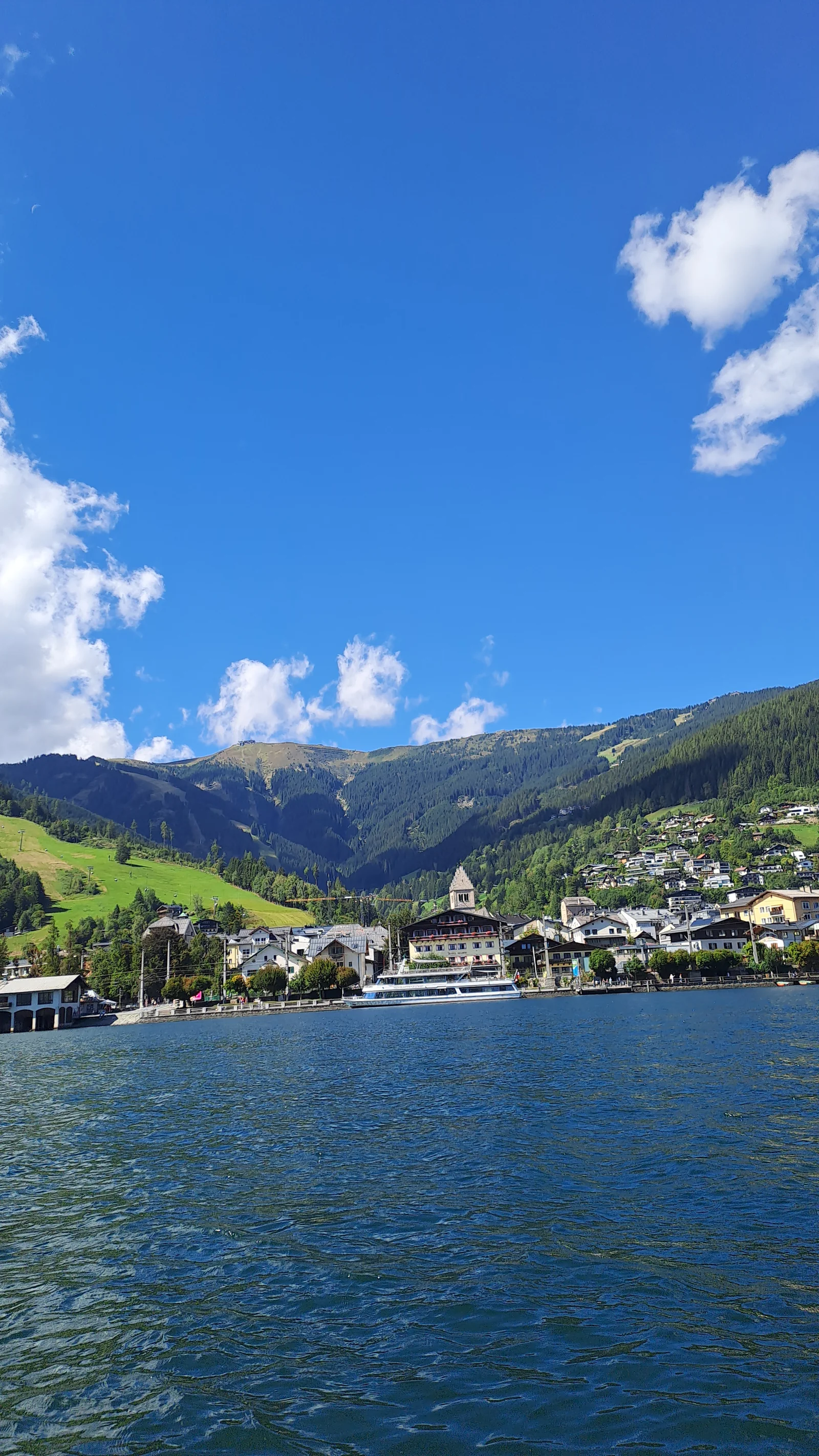
Salzburg's water monitoring rates the bathing sites here at the top EU grade, which it has done for years. The hotel's jubilee journal puts it more cheerfully and says that anyone who swallows a mouthful jumping in has nothing to worry about.
There is a passenger boat as well, the MS Schmittenhöhe, built at the Lux yard in 2005 and in service since 2006, three decks and room for 255 people. The circuit takes about three quarters of an hour and it is free with the regional guest card. It is the easier option and the less interesting one. The hired boat lets you stop.
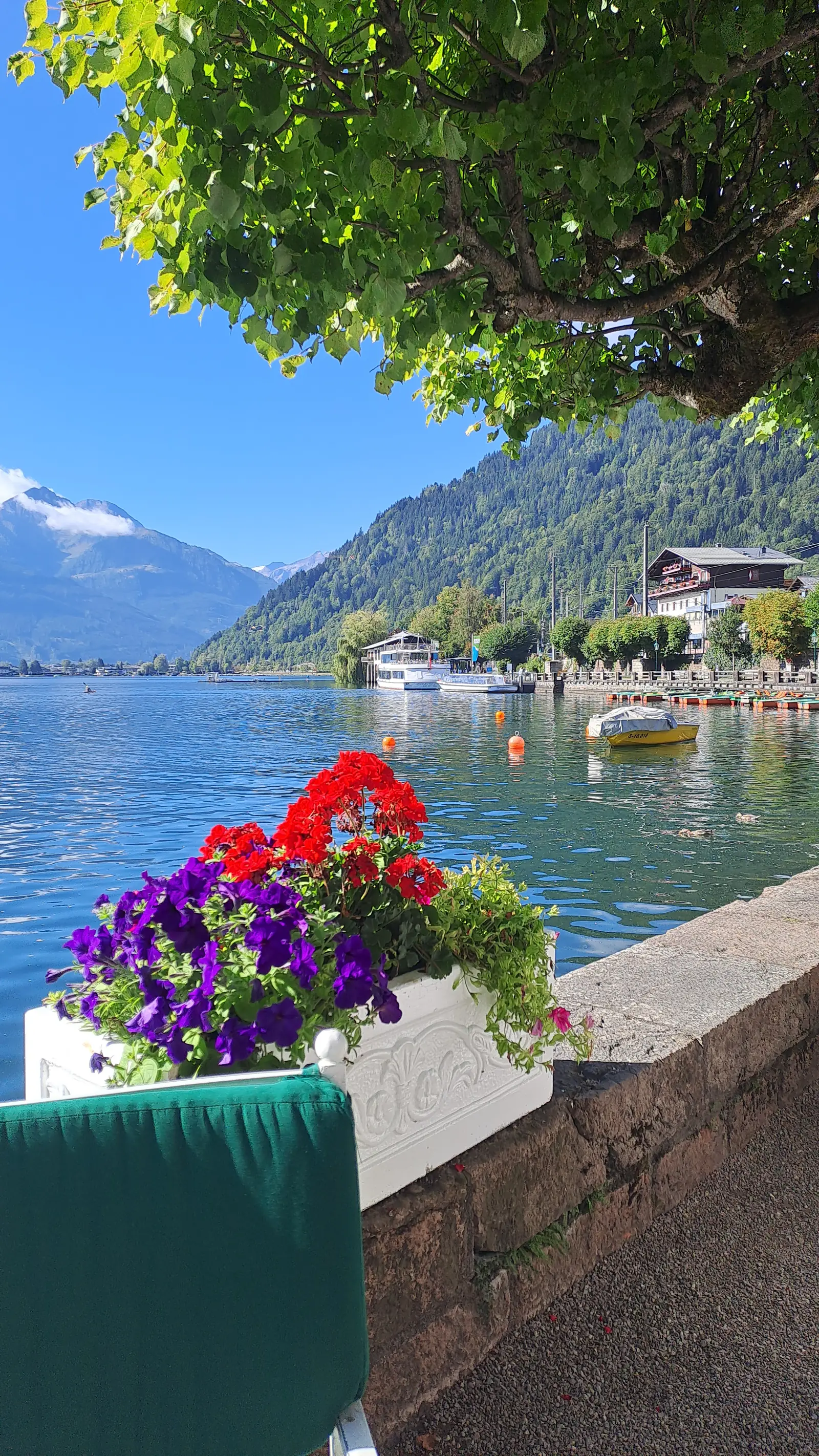
The lake used to be a working surface
It froze thick most winters. In the six weeks between late February and mid-March 1884, the town cut and shipped 3,133 railway wagons of ice to icehouses at home and abroad. In the 1950s people skated on it and ran motorbike and Porsche races across it.
None of that is possible now, which is its own quiet piece of information.
What we actually know
- Combustion engines are prohibited on the lakes of Salzburg province. Electric and muscle-powered craft only.
- The Zeller See covers 4.55 square kilometres, reaches 69.8 metres at its deepest, holds 180.6 million cubic metres and lies at about 750 metres above sea level. Official Land Salzburg figures.
- Salzburg’s bathing-water monitoring has rated the sites here “ausgezeichnet”, the top EU grade, for years running.
- The MS Schmittenhöhe was built at the Lux yard in 2005 and entered service in 2006. Three decks, room for 255 passengers, a circuit of about 45 minutes.
- The Schmittenhöhe rises to 1,965 metres west of the town, the Hundstein to 2,117 metres across the water.
- Between late February and mid-March 1884 the town shipped 3,133 railway wagons of cut lake ice. The figure comes from the hotel’s own jubilee journal.
The peninsula was enlarged with driven piles in the late 1880s. That account comes from the hotel and we have not found it in an independent source, so it is published as the hotel’s own history rather than as established fact.
How this story was made. Photographed on a phone, from a hired boat and on foot. Nothing here is sponsored, nothing was provided free, and the stay and the boat were found, booked and paid for at our own cost. Figures for the lake come from Land Salzburg; the historical detail is attributed to the hotel’s jubilee journal where it comes from there.
Independent and self-funded. Atlántis is not sponsored by design: not affiliated, not a paid placement, and nobody we write about knew in advance. Everything on this page was found, booked and paid for at our own cost. The views are our own, judged against the Atlántis values: sustainability, cultural immersion, eco travel, real experiences, family-friendliness, and car-free travel or the deep past, depending on the place.